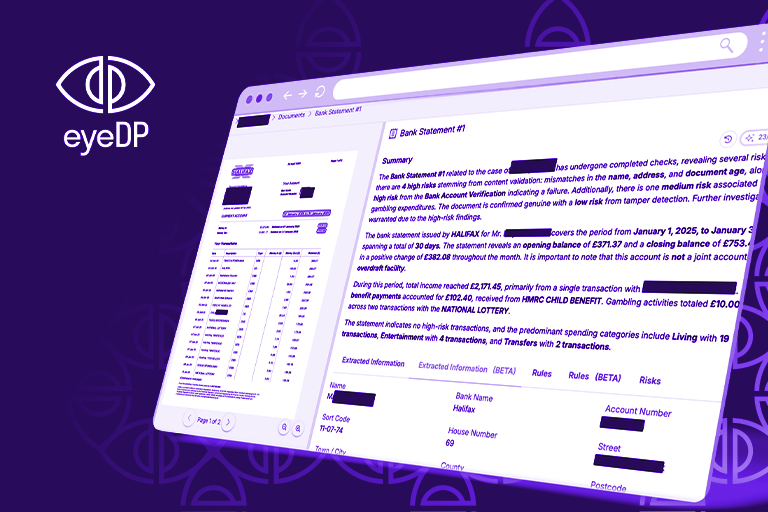

A document review system flags an inconsistency between two submissions. What happens next? Can the reviewer see the relevant information? Do they understand why it needs attention? Can they investigate further and challenge the finding before making a decision?
The answers determine whether human oversight has a meaningful role in the workflow.
For regulated businesses, keeping a person involved is only the starting point. Effective review means giving that person the evidence, context and authority to assess what AI has identified.
- Reviewers need evidence they can assess
A flag tells a team where to look. It does not, by itself, explain what the information means.
A difference between documents might indicate a concern, but it could also reflect a change in circumstances, an incomplete submission or an issue that needs clarification. Reviewers need to examine the underlying information before deciding how to respond.
AI-supported document review should help teams move from finding an issue to understanding it. That means making the relevant evidence accessible and giving reviewers a clear basis for further investigation.
eyeDP uses AI to analyse and cross-reference document information, helping surface discrepancies and connections that may be difficult to identify through manual checks alone. Those insights support the reviewer’s assessment.
- An automated finding should remain open to challenge
Human oversight becomes less effective when teams treat an automated result as a conclusion they are expected to accept.
A discrepancy is a reason to investigate. It is not automatically proof of wrongdoing. Equally, the absence of a flagged issue does not remove the need to consider the purpose of the review or the wider circumstances.
Reviewers should be able to question a finding, request additional information and escalate a case when necessary. Their responsibility is to assess the evidence and determine the appropriate next step.
As eyeDP CEO Warren Russell explains:
“Our goal at eyeDP is not to take accountability away from human operators.”
AI contributes analytical support. People remain responsible for how that support informs a decision.
- Reviews need time and attention
Even a well-designed review process can struggle if teams do not have enough capacity to investigate exceptions properly.
When reviewers spend much of their day extracting information, comparing documents and repeating routine checks, less time remains for cases that require closer consideration.
This is where automation can make human oversight stronger. Reducing repetitive work creates room for teams to examine inconsistencies, understand customer circumstances and follow up on missing evidence.
The operational benefit is therefore broader than faster processing. It is the opportunity to use skilled people’s time more effectively.
When assessing a document review workflow, businesses should ask whether automation is helping reviewers concentrate on the cases that need their judgement.
- The reasoning behind a decision should be traceable
A completed review should leave a clear account of how the outcome was reached.
That requires a distinction between the information submitted, the findings generated during analysis and the reviewer’s assessment. Each plays a different role.
An AI-generated insight may prompt further investigation. Additional evidence may resolve the concern. The reviewer then needs to explain why the available information supports the next step.
Maintaining that distinction helps businesses examine their processes, review decisions and identify where improvements are needed. It also makes accountability clearer: the system’s finding and the person’s judgement should not become indistinguishable.
- Secure information handling supports effective oversight
Document review can involve sensitive personal and financial information. Teams need access to the evidence required for their work, within appropriate controls.
Security and oversight therefore need to work together. Businesses should understand how documents are handled, who can access them and how information is protected throughout the review process.
eyeDP holds ISO/IEC 27001 certification, reflecting our commitment to information security management. Protecting information is an essential part of building confidence in the technology and the processes around it.
A shared approach to AI and human judgement
Our recently announced partnership with Mindway AI reflects this same principle: technology delivers greater value when it supports human expertise. Mindway AI’s GameScanner combines artificial intelligence, neuroscience and expert human assessment to identify early signs of at-risk and problem gambling behaviour. eyeDP brings complementary document verification and analysis capabilities, helping teams detect inconsistencies and assess supporting evidence.
The planned integration will bring these capabilities together, connecting document-based insights with behavioural risk signals to help operators build a fuller customer picture. Both companies share a commitment to using AI to support more informed and timely decisions, while keeping people responsible for assessing findings and determining the appropriate action.
eyeDP’s approach to document intelligence focuses on reducing manual effort and helping teams identify relevant information, while keeping human judgement central to decision-making.
Want to explore how AI can support your document review team? Book an eyeDP demo.